Blog – hamster kombat daily combo

Essential Legal Documents and Compliance When Starting a New Business
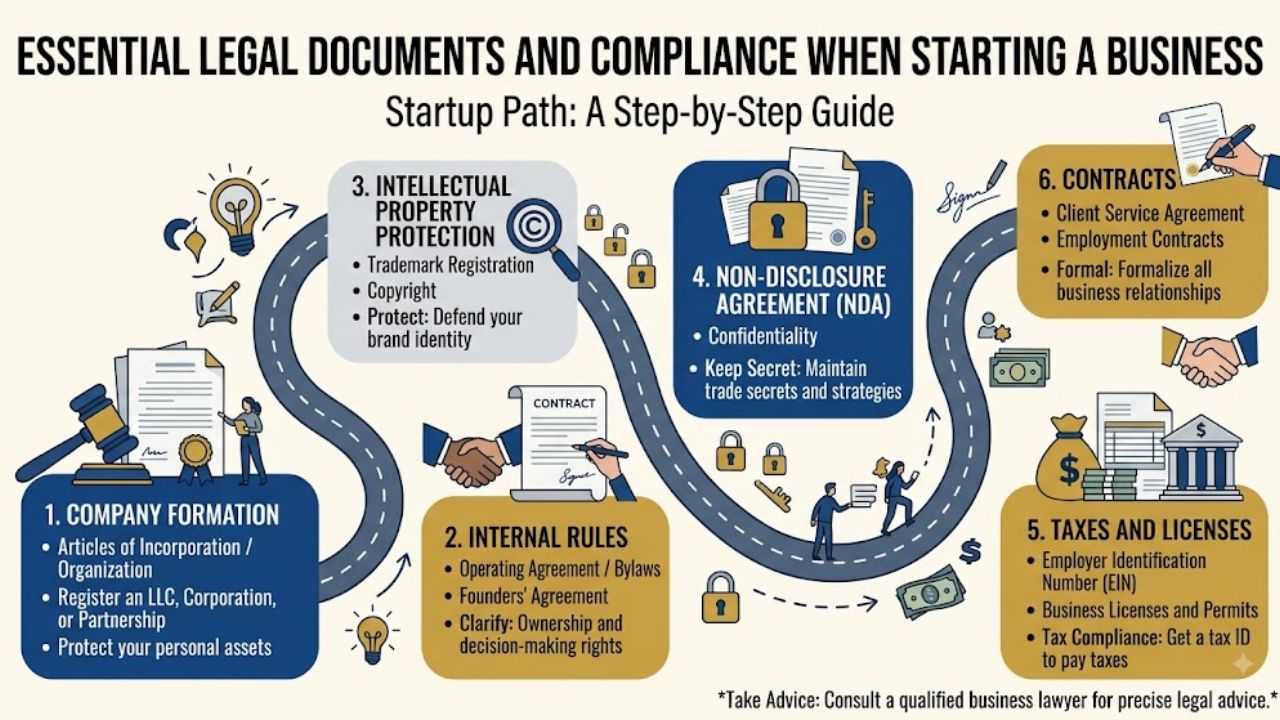
Launching a new business is an exciting venture, but a great idea is not enough to guarantee long-term success. Without a solid legal foundation, your startup is highly vulnerable to co-founder disputes, intellectual property theft, and expensive government fines. Many new entrepreneurs make the critical mistake of treating legal compliance as an afterthought. However, setting up the right legal framework from day one protects your personal assets, builds trust with early investors, and ensures your operations are entirely legitimate. This comprehensive guide breaks down the essential legal documents and compliance steps required when starting a new business. Quick Reference: Core Startup Legal Documents Use this checklist to ensure your business covers all immediate legal bases before launching products or services to the public. Compliance Area Essential Legal Document Primary Purpose High CPC Keywords Business Formation Articles of Incorporation / Organization Legally creates your business entity (LLC or Corporation) with the state. Company registration, LLC formation services Internal Governance Operating Agreement / Bylaws Outlines ownership structures, voting rights, and profit distribution. Startup legal documents, Corporate bylaws Brand Protection Trademark Registration Protects your company name, logo, and slogans from competitors. Intellectual property lawyer, Trademark registration Confidentiality Non-Disclosure Agreement (NDA) Prevents employees and contractors from sharing your trade secrets. Business lawyer, NDA drafting Tax Compliance Employer Identification Number (EIN) A federal tax ID used for filing taxes, hiring employees, and opening bank accounts. Apply for EIN, Business tax compliance 1. Register Your Business Entity Correctly Operating as a Sole Proprietorship is easy, but it exposes your personal assets (like your house and savings) to business liabilities. You must establish a separate legal entity. Choose the Right Structure: Decide between a Limited Liability Company (LLC), an S-Corporation, or a C-Corporation based on your tax preferences and funding goals. File Articles of Organization: Submit these foundational documents to your local government or state authorities to officially register your business name and entity type. Appoint a Registered Agent: Most jurisdictions require you to designate a registered agent—a person or service authorized to receive official legal and tax correspondence on behalf of your business. 2. Draft an Operating Agreement or Founders’ Agreement If you are starting a business with partners, a verbal agreement is a recipe for disaster. You need a legally binding contract that dictates how the business is run. Define Equity and Ownership: Clearly document the percentage of the company each founder owns. Outline Roles and Responsibilities: Specify who handles daily operations, financial decisions, and strategic planning. Create an Exit Strategy: Include a “Buy-Sell” clause that dictates exactly what happens to a founder’s shares if they decide to leave the company, become incapacitated, or pass away. 3. Protect Your Intellectual Property (IP) Your brand identity, proprietary software, and unique processes are often your most valuable assets. You must legally claim them before someone else does. File for Trademarks: Protect your business name, logo, and main product names by registering them with the national patent and trademark office. Sign Invention Assignment Agreements: Ensure that any code, designs, or products created by founders, employees, or contractors are legally owned by the company, not the individual creator. 4. Obtain Necessary Tax IDs, Licenses, and Permits Compliance goes beyond just registering your business name; you must ensure you are legally allowed to operate in your specific industry and location. Get an EIN: Apply for an Employer Identification Number (EIN) from the federal tax authority. This is essential for opening a business bank account and paying taxes. Check Local Zoning Laws: Ensure your business address is zoned correctly for your type of operation, especially if you are opening a physical retail storefront or a manufacturing facility. Apply for Industry-Specific Permits: Depending on your niche, you may need health department permits (for food services), professional licenses (for legal or financial consulting), or specialized sales tax permits. 5. Establish Ironclad Contracts for Employees and Clients Handshake deals offer zero protection in a courtroom. Every business relationship must be defined by clear, written contracts. Client Service Agreements: Draft standard Terms and Conditions (T&Cs) that outline your payment terms, scope of work, and liability limitations to protect against customer disputes. Employment Contracts: Clearly define compensation, benefits, termination conditions, and expectations for all new hires. Implement NDAs: Require contractors, vendors, and employees to sign Non-Disclosure Agreements before exposing them to your sensitive business data or client lists. Conclusion Setting up a business requires much more than just a catchy name and a website. Establishing the proper legal entity, drafting binding internal agreements, securing your intellectual property, and maintaining tax compliance are non-negotiable steps for long-term survival. Because a single legal mistake can bankrupt a startup, it is highly recommended to consult with a qualified business lawyer to draft your foundational documents and ensure absolute compliance in your jurisdiction. Disclaimer: This article is for informational and educational purposes only and does not constitute professional legal advice. Laws and compliance requirements vary significantly by state, country, and industry. Always consult with a licensed business attorney for guidance specific to your startup.
REITs vs. Direct Property: Which is the Better Real Estate Investment?

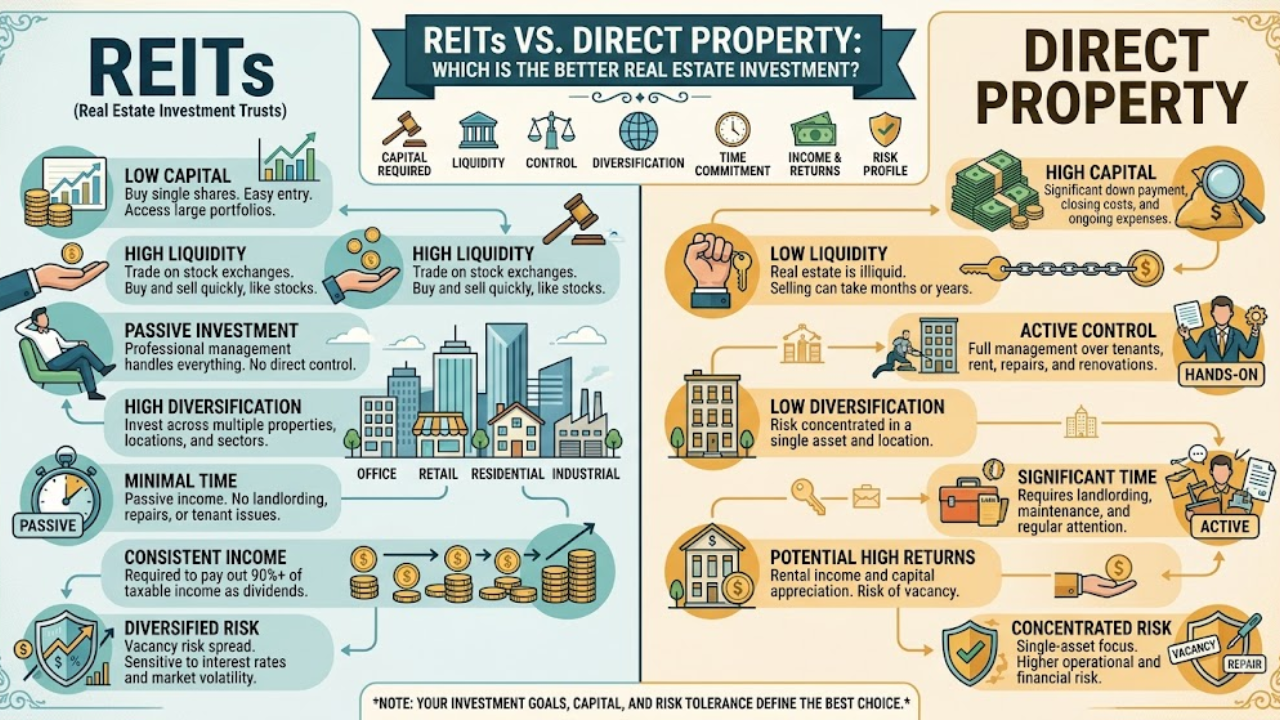
Real estate has long been a cornerstone of wealth creation, offering a proven hedge against inflation and a reliable source of cash flow. However, the way you choose to invest in real estate drastically changes your financial commitments, risk exposure, and daily responsibilities. Today, investors face a primary crossroads: buying physical properties directly or investing in Real Estate Investment Trusts (REITs). While direct property offers tangible ownership and unique tax advantages, it requires significant capital and hands-on management. Conversely, REITs offer stock-market liquidity and passive income but strip away your control over the underlying assets. Here is a comprehensive breakdown to help you decide which investment vehicle is right for your portfolio. Quick Reference: REITs vs. Direct Property To determine the best fit for your financial goals, you must evaluate how much time, money, and control you are willing to commit. Investment Metric REITs (Real Estate Investment Trusts) Direct Property (Physical Real Estate) Capital Required Low: You can buy single shares for a fraction of the cost of a property. High: Requires a substantial down payment, closing costs, and a maintenance reserve. Liquidity High: Traded on public stock exchanges; can be bought or sold instantly. Low: Highly illiquid; selling a physical property can take months or even years. Time Commitment Minimal (Passive): Professional management handles all operations and tenant issues. Significant (Active): Requires hands-on management of tenants, repairs, and maintenance. Diversification High: A single REIT holds dozens or hundreds of properties across various sectors. Low: Risk is highly concentrated in a single asset and a specific geographic location. Control None: You have no say in property management, acquisitions, or sales. Complete: You have full authority over renovations, tenant selection, and rent pricing. 1. The Case for REITs (Real Estate Investment Trusts) A REIT is a company that owns, operates, or finances income-generating real estate. By purchasing shares of a REIT, you pool your money with other investors to earn dividends from real estate investments without having to buy, manage, or finance any properties yourself. The Advantages of REITs Highly Accessible: You do not need a mortgage or hundreds of thousands of dollars to start. You can invest in a REIT through a standard brokerage account. Consistent Passive Income: By law, REITs are required to distribute the vast majority of their taxable income (typically 90% or more) to shareholders in the form of dividends. Instant Diversification: You can easily invest in specialized sectors that are normally out of reach for individual investors, such as commercial skyscrapers, data centers, or healthcare facilities. The Drawbacks of REITs Market Volatility: Because public REITs trade on stock exchanges, their share prices are subject to daily market fluctuations and broader economic sentiment, regardless of the underlying property values. Tax Inefficiency: Unlike qualified dividends from standard stocks, REIT dividends are generally taxed as ordinary income, which can trigger a higher tax burden for top earners. 2. The Case for Direct Property Investment Direct property investing means you are purchasing a physical asset—like a single-family rental, a duplex, or a commercial storefront. You are the landlord, and you are directly responsible for the asset’s performance. The Advantages of Direct Property Powerful Leverage: You can purchase a highly valuable asset using a relatively small amount of your own money (the down payment) while a bank finances the rest. Your returns are based on the total asset value, not just your initial cash investment. Massive Tax Shields: Physical real estate offers unparalleled tax benefits. You can deduct operating expenses, mortgage interest, and utilize depreciation to significantly lower your taxable rental income. You can also use 1031 exchanges to defer capital gains taxes indefinitely. Forced Appreciation: Unlike a REIT, you can actively increase the value of a physical property through strategic renovations, better management, or increasing the rent. The Drawbacks of Direct Property The “Toilet and Tenant” Factor: Direct real estate is not truly passive. Dealing with late rent payments, plumbing emergencies, and property vacancies requires time, energy, and stress. High Barrier to Entry: Acquiring physical real estate requires excellent credit, a large cash down payment, and a solid financial cushion to handle unexpected repairs. Conclusion: Which Should You Choose? There is no universally “better” option—only the option that best fits your current financial reality. If you want truly passive income, have limited starting capital, and prioritize liquidity, REITs are the clear winner. However, if you have substantial capital to deploy, want to maximize tax advantages, and are willing to take on the active responsibilities of a landlord to build generational wealth, Direct Property is the superior vehicle. Many well-diversified investors ultimately choose to hold a combination of both. Disclaimer: This article is for informational purposes only and does not constitute professional financial or investment advice. Real estate markets carry inherent risks. Always consult with a certified financial planner or real estate professional before making major investment decisions.

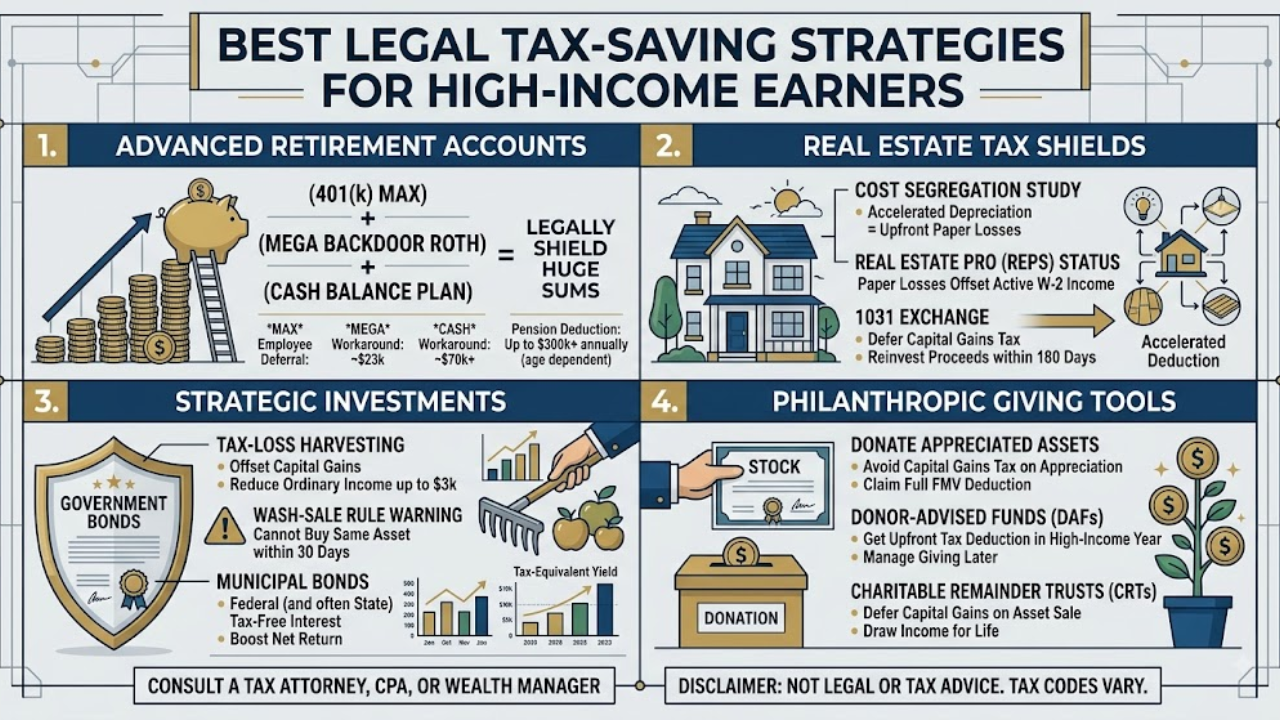
Best Legal Tax-Saving Strategies for High-Income Earners

As your income grows, your tax liability increases significantly. For high earners, taxes often represent the single largest annual expense, with top federal, state, and local rates consuming over 40% of total revenue. However, earning a high income does not mean you have to hand over a massive chunk of your hard-earned wealth. The tax code contains built-in incentives designed to reward specific behaviors, such as investing in capital assets, providing retirement security, and supporting charitable causes. By utilizing proactive, legal tax mitigation strategies, high-income individuals can legally protect their assets, maximize capital growth, and keep more money in their portfolios. Quick Reference: Top Tax Reduction Strategies Strategy Primary Benefit Best Suited For High CPC Target Keywords Maxing Tax-Advantaged Accounts Pre-tax deductions and tax-free growth High W-2 Earners & Executives 401k max contribution, Mega Backdoor Roth Real Estate Depreciation & 1031s Defer capital gains & offset active/passive income Real Estate Investors & Business Owners Cost segregation study, 1031 exchange rules Municipal Bond Portfolios Federal (and often state) tax-free interest income High Net Worth Investors Tax-free municipal bonds, Wealth management Donor-Advised Funds (DAFs) Upfront tax deductions for charitable giving High Earners with Peak Income Years Donor advised fund tax benefits, Tax attorney Tax-Loss Harvesting Offsets capital gains and up to $3,000 of ordinary income Active Stock & Crypto Investors Tax loss harvesting software, Capital gains tax strategy 1. Maximize Advanced Retirement Accounts (Beyond Standard 401ks) Standard retirement contributions are a great start, but high earners need to look beyond the basic annual limits to shield larger sums from taxation. Mega Backdoor Roth IRA: If your employer’s 401(k) plan allows after-tax contributions and in-plan Roth conversions, you can contribute significantly more than the standard 401(k) limit each year into a Roth account, enabling tax-free growth forever. Defined Benefit / Cash Balance Plans: For high-earning business owners and self-employed consultants, setting up a Cash Balance Pension Plan allows you to defer up to several hundred thousand dollars annually in pre-tax income, depending on your age. Health Savings Accounts (HSAs): Often overlooked, an HSA offers a “triple tax advantage”—contributions are tax-deductible, growth is tax-free, and withdrawals for qualified medical expenses are 100% tax-free. 2. Leverage Real Estate Tax Shields and Depreciation Real estate remains one of the most powerful wealth-building tools due to its unique, highly favorable tax treatments. Cost Segregation Studies: Commercial and residential property owners can use a cost segregation study to accelerate property depreciation. This allows you to write off property components (like lighting, carpeting, and land improvements) over 5 to 15 years instead of 27.5 or 39 years, generating massive upfront paper losses. Real Estate Professional Status (REPS): If you or your spouse qualify as a Real Estate Professional under tax rules, you can use paper losses from real estate depreciation to directly offset ordinary W-2 or business income. 1031 Exchanges: When selling real estate, defer paying 100% of capital gains taxes by reinvesting the proceeds into another “like-kind” property. 3. Utilize Tax-Loss Harvesting to Offset Gains If you hold a taxable investment portfolio, market volatility presents a valuable tax-saving opportunity. Offset Capital Gains: Tax-loss harvesting involves selling underperforming investments at a loss to balance out capital gains realized from profitable assets. Reduce Ordinary Income: If your total losses exceed your total capital gains in a tax year, you can use up to $3,000 of the remaining losses to offset ordinary income, carrying over any remaining losses into future tax years. Mind the Wash-Sale Rule: To preserve the tax deduction, ensure you do not buy the same asset (or a substantially identical one) within 30 days before or after the sale. 4. Invest in Tax-Exempt Municipal Bonds For investors in the highest tax brackets, income generated from standard savings accounts or corporate bonds can be taxed at steep rates. Federal and State Tax-Free Returns: Interest earned from municipal bonds issued by state and local governments is completely exempt from federal income tax. In-State Exemption: If you buy municipal bonds issued by your home state or local municipality, the interest is usually exempt from state and local income taxes as well. Tax-Equivalent Yield Advantage: Calculate the “tax-equivalent yield” of municipal bonds—often, a lower yield on a tax-free bond delivers a higher net return than a higher yield on a taxable bond for top-tier earners. 5. Implement High-Impact Charitable Giving Tools If you plan to donate to charity, doing so strategically can significantly lower your taxable income while amplifying your philanthropic impact. Donate Appreciated Assets: Instead of donating cash, donate long-term appreciated stock or real estate directly to charity. You get a tax deduction for the full fair market value and avoid paying capital gains tax on the appreciation. Donor-Advised Funds (DAFs): A DAF lets you make a large, tax-deductible charitable contribution in a high-income year and distribute the funds to charities over several years at your own pace. Charitable Remainder Trusts (CRTs): High earners with highly appreciated assets can place those assets into a CRT, receive an immediate tax deduction, draw income from the trust for life, and leave the remaining balance to charity. Conclusion Tax planning is not about evading taxes—it is about structuring your investments and income efficiently within legal guidelines. Because tax laws are intricate and subject to frequent updates, high-income earners should always work with a qualified Tax Attorney, CPA, or Fee-Only Wealth Manager to build a customized, compliant strategy tailored to their financial goals. Disclaimer: This article is strictly for educational and informational purposes and does not constitute legal, tax, or financial advice. Tax codes vary by jurisdiction and personal circumstances. Always consult with a licensed CPA or tax attorney before executing any complex tax strategy.

Home Loan Refinancing: How to Successfully Lower Your Interest Rate

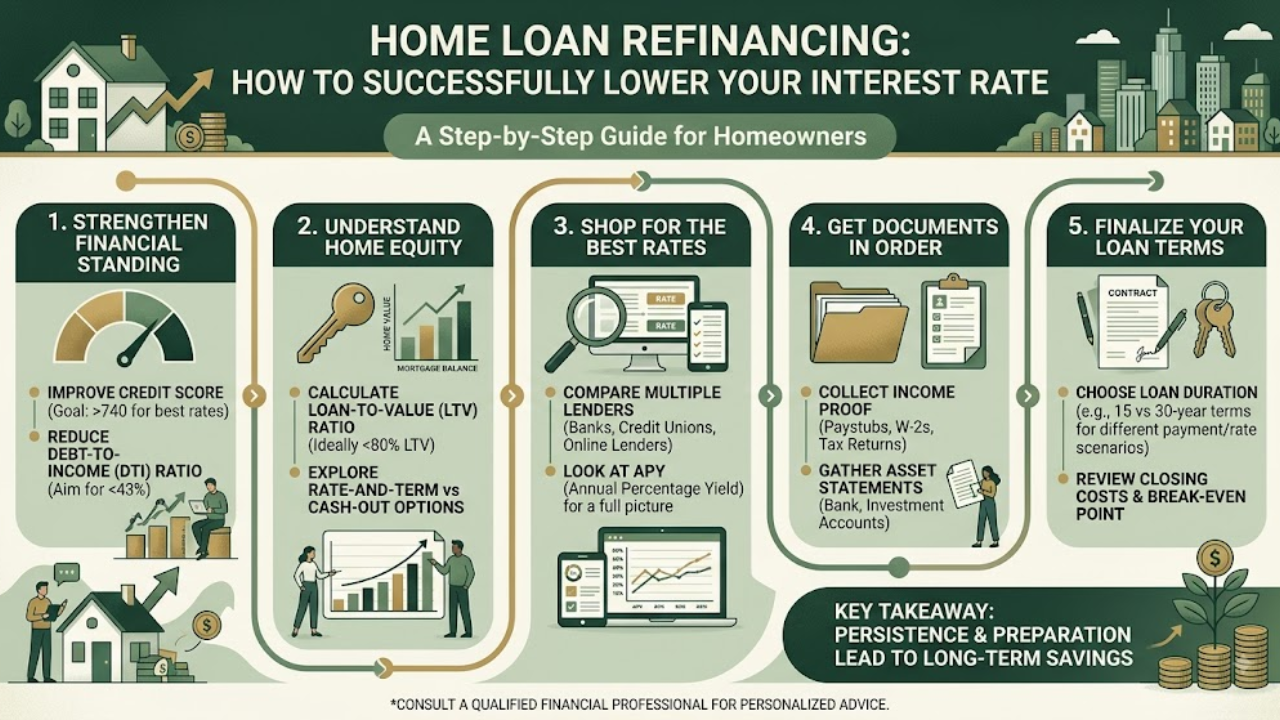
F or most homeowners, a mortgage is the largest financial commitment they will ever make. However, the interest rate you signed up for when you first bought your home doesn’t have to be the rate you keep forever. Home loan refinancing (or mortgage balance transfer) is a strategic financial tool that allows you to replace your existing home loan with a new one—ideally with a lower interest rate and better terms. When executed correctly, refinancing can reduce your monthly EMI (Equated Monthly Installment), help you pay off your home faster, and save you thousands in interest. Here is your definitive guide to successfully lowering your rate. Quick Reference: Should You Refinance? Before starting the process, evaluate if refinancing makes financial sense for your current situation. Financial Goal When It Makes Sense High CPC Target Keywords to Research Lower Monthly Payments When current market interest rates drop at least 0.5% to 1% below your existing rate. Mortgage refinance rates today, Lowest EMI home loan Pay Off Loan Faster When you want to switch from a 30-year term to a 15-year term to build equity quickly. 15-year refinance rates, Short term mortgage refinance Switch Rate Types When moving from an unpredictable adjustable-rate mortgage (ARM) to a stable fixed-rate mortgage. Fixed rate mortgage refinance, ARM to fixed refinance Cash-Out Equity When you have significant home equity and need funds for major expenses like renovations. Cash-out refinance rates, Home equity loan vs refinance 1. Improve Your Credit Score First Lenders reserve their absolute best interest rates for borrowers with excellent credit. Before you apply for a refinance, check your credit report. Check for Errors: Review your credit report for any inaccuracies that might be dragging your score down and dispute them immediately. Lower Credit Utilization: Pay down existing credit card balances. A credit utilization ratio below 30% significantly boosts your score. Avoid New Debt: Do not apply for auto loans or new credit cards in the months leading up to your refinance application. 2. Calculate Your Home Equity Your home equity is the difference between your property’s current market value and your outstanding loan balance. Lenders look closely at your Loan-to-Value (LTV) ratio. Target a 20% Equity Cushion: If you have at least 20% equity in your home (an LTV of 80% or less), you will secure much better interest rates and can usually avoid paying Private Mortgage Insurance (PMI). Get a Preliminary Appraisal: Real estate markets fluctuate. Look at recent sales of similar homes in your neighborhood to estimate your current property value. 3. Shop Around and Compare Multiple Lenders Loyalty doesn’t always pay in the mortgage industry. Your current bank might not offer you the most competitive refinancing rate. Get Multiple Quotes: Request Loan Estimates from at least three different lenders, including traditional banks, credit unions, and online mortgage brokers. Look Beyond the Interest Rate: Pay close attention to the Annual Percentage Rate (APR). The APR includes the interest rate plus broker fees, discount points, and closing costs, giving you the true cost of the loan. 4. Watch Out for Hidden Fees and Closing Costs Refinancing is not free. Creating a new loan involves administrative, legal, and processing fees. You must calculate the “break-even point” to ensure the refinance is actually profitable. Typical Closing Costs: Expect to pay between 2% to 5% of the total loan amount in closing costs (origination fees, appraisal fees, title search, etc.). Calculate the Break-Even Point: Divide your total closing costs by your monthly savings. (e.g., If closing costs are $3,000 and you save $100 a month, it will take 30 months to break even. If you plan to move before 30 months, refinancing is a bad idea). Check for Prepayment Penalties: Verify if your current lender charges a fee for paying off your original mortgage early. 5. Lock in Your Rate and Finalize the Paperwork Interest rates change daily based on bond markets and economic data. Once you find a rate that meets your financial goals, act quickly. Request a Rate Lock: Ask your lender for a rate lock (usually valid for 30 to 60 days). This protects you from sudden rate hikes while your application is being processed. Prepare Your Documentation: Gather your recent pay stubs, W-2s, tax returns for the last two years, and bank statements to ensure a smooth underwriting process. Conclusion Refinancing your home loan is a powerful way to take control of your personal finances. By improving your credit score, comparing multiple lenders, and carefully calculating the break-even point, you can successfully lower your interest rate and secure your long-term financial health. Disclaimer: This article is for informational purposes only and does not constitute professional financial advice. Interest rates and loan terms vary by location and individual financial circumstances. Always consult with a certified financial planner or mortgage advisor before making major financial decisions.

The Essential Legal Checklist Before Buying Commercial Property

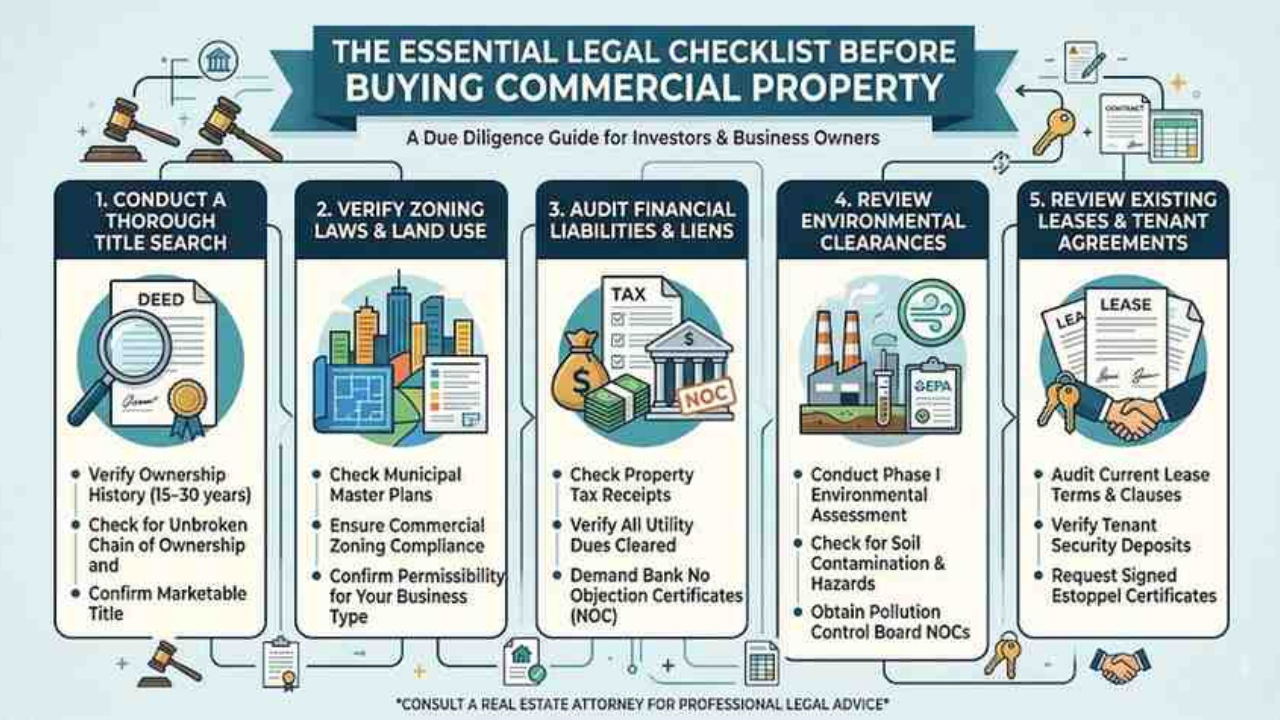
Investing in commercial real estate is one of the most profitable financial moves you can make, but it also carries significant risk. Unlike residential real estate, commercial property transactions involve complex legalities, zoning laws, and massive financial commitments. Skipping proper legal due diligence can result in expensive lawsuits, voided contracts, or buying a property you cannot legally use for your business. To protect your investment, you need a bulletproof legal strategy. This essential legal checklist covers everything you must verify before closing the deal on a commercial property. Quick Reference: Commercial Property Legal Checklist Verification Category Key Documents to Check Why It Matters Title & Ownership Sale Deed, Mother Deed, Encumbrance Certificate Ensures the seller has the absolute legal right to sell the property. Zoning & Land Use Municipal Master Plan, Zoning Clearances Confirms your specific business type is legally allowed on the premises. Financial Liabilities Property Tax Receipts, Bank NOCs Protects you from assuming the previous owner’s debts and unpaid taxes. Environmental Laws EPA Clearances, Pollution Control Board NOC Prevents hefty fines for pre-existing environmental hazards on the land. Existing Leases Tenant Agreements, Estoppel Certificates Clarifies your legal obligations to current tenants occupying the building. 1. Conduct a Thorough Title Search The most critical step in buying commercial property is verifying the title. A clear and marketable title guarantees that the seller actually owns the property and has the legal authority to transfer ownership to you. Trace the Ownership History: Your real estate attorney should trace the property’s title back at least 15 to 30 years to ensure an unbroken chain of ownership. Verify the Mother Deed: This is the foundational document of the property. Ensure it is registered and readily available. Check for Joint Ownership: If the property has multiple owners, all parties must legally consent to the sale to prevent future disputes. 2. Verify Zoning Laws and Land Use Permissions Just because a property looks like a retail store doesn’t mean it is legally zoned for one. Zoning laws dictate exactly how a property can be used. Check Municipal Zoning Maps: Ensure the property is strictly zoned for commercial use, not residential or agricultural. Verify Specific Business Permissibility: If you plan to open a restaurant, factory, or medical facility, confirm that the local zoning ordinances allow that specific type of business. Look for Future City Planning Changes: Ensure there are no upcoming highway expansions or municipal projects that could result in eminent domain claims against your property. 3. Check for Encumbrances and Liens An encumbrance is a claim against the property by a party that is not the owner. Buying a property with an active lien means you are also buying the previous owner’s legal troubles. Obtain an Encumbrance Certificate: This legal document will reveal any registered mortgages, liens, or third-party claims against the property. Demand a Bank NOC: If the seller previously took a loan against the property, they must provide a No Objection Certificate (NOC) from the bank proving the debt is fully cleared. 4. Review Environmental Clearances Environmental compliance is a massive factor in commercial real estate. If the land is contaminated, the new owner is often held legally and financially responsible for the cleanup, regardless of who caused it. Conduct an Environmental Site Assessment (ESA): A Phase I ESA will identify any potential environmental hazards like soil contamination or hazardous waste. Check Local Pollution Control Rules: Manufacturing or industrial properties must have up-to-date clearances from local environmental and pollution control boards. 5. Audit Existing Commercial Leases If you are buying a commercial building that already has tenants, you inherit those lease agreements. You cannot arbitrarily kick tenants out or raise the rent without legal backing. Review All Lease Agreements: Check the duration, renewal clauses, and rent escalation terms for every existing tenant. Obtain Tenant Estoppel Certificates: This is a document signed by the tenant confirming the terms of their lease and stating that the landlord owes them no pending obligations. Check Security Deposits: Ensure the seller transfers all tenant security deposits to your accounts at closing. 6. Clear All Pending Taxes and Utility Dues Unpaid property taxes stay attached to the property, not the person. If the seller owes taxes, the government can seize the property even after you buy it. Verify Property Tax Receipts: Demand to see the most recent tax receipts to confirm there are no outstanding municipal dues. Check Utility Bills: Ensure electricity, water, and commercial maintenance bills are cleared up to the date of possession. Conclusion Buying commercial property is a high-stakes financial transaction. A single overlooked document can turn a lucrative investment into a legal nightmare. Always hire an experienced commercial real estate lawyer to perform comprehensive due diligence before signing a purchase agreement. By strictly following this checklist, you can confidently secure your commercial real estate investment. Disclaimer: This article is for informational purposes only and does not constitute professional legal or financial advice. Always consult with a qualified commercial real estate attorney in your local jurisdiction before making property investments.

Night Guitarist with Modern Sedan

Night Guitarist with Modern Sedan

A candid, ultra-realistic night shot of a young man playing an acoustic guitar while leaning against a modern grey sedan with a red LED taillight bar. Prompt –  Create image A candid, ultra-realistic night shot of a young man with thick messy hairstyle, leaning against the back of a modern grey sedan, playing an acoustic guitar. The man is wearing a yellow oversized shirt, grey baggy jeans, and sneakers. The car features a distinctive continuous red LED taillight bar across the trunk. The background includes palm trees and streetlights under a dark night sky.

Office Swag Portrait

Office Swag Portrait

A high-fidelity candid flash photography blueprint for professional office-style portraits with a stylish, modern aesthetic. Prompt – Keeping the facial features exact same without any alterations generate A candid, sharp-flash photography shot from a low, side perspective of an olive-skinned young man from reference image sitting casually in an office chair. He is making eye contact with the camera, resting his hand thoughtfully near his chin. His left foot, wearing white sneakers with black stripes, is resting cross on right leg, sitting with swag and stylish, dominating the foreground. He is dressed in an oversized white graphic tee with “Invest InYourself – mohan creator” written in green serif text, and loose olive green cargo pants. Accessories include a silver watch and a simple bracelet. The background is a white, paneled room with typical desk clutter like a small printer, a pencil holder, and a desk toy. The lighting is direct and hard, creating distinct shadows on the background wall. Same face , body proportion compulsory, and thick messy combed hairstyle

Vintage Train Station Romance

A nostalgic and emotional cinematic photography blueprint capturing a romantic encounter at a vintage train station during golden hour. Prompt –   Create ultra realistic cinematic photography of a romantic scene at a vintage train station, a young man with same hair, standing on a platform beside a classic dark green train carriage, side profile view, wearing a dark jacket layered over a shirt, holding a bouquet of vibrant purple flowers wrapped in transparent plastic, looking up with a warm affectionate smile a young women(image uploaded), leaning out of a train holding window above him, half-body visible tied half-up, wearing a dark blue outfit, gazing down with a loving gentle smile, their faces very close, emotional intimacy and romantic tension Environment: vintage train carriage with glowing warm yellow lights from inside windows, soft golden hour lighting, warm cinematic tone, dreamy atmosphere, shallow depth of field, smooth bokeh background, slight film grain Composition: rule of thirds, cinematic framing, medium close-up, eye-level with man and slightly low angle toward women, soft focus falloff, natural light diffusion aesthetic: romantic, nostalgic, emotional storytelling, golden light reflections, subtle lens flare, volumetric light, high dynamic range, hyper detailed skin texture, natural color grading style: photorealistic, cinematic, 85mm lens, f/1.8, HDR, 8k resolution, sharp focus on subjects, smooth background blur –ar 9:16 –v 6 –style raw –q 2

Elevator Mirror Selfie

A modern, raw urban aesthetic full-body mirror selfie in front of a stainless steel elevator, capturing a stylish and relatable lifestyle vibe. Prompt – Create a image A full-body mirror selfie of a young stylish man slight gym body standing in front of closed stainless steel elevator doors. He is holding a space black colour I phone in front of his face, partially obscuring it. He has messy hairstyle, He is wearing a light-colored vertically strips full sleeve rolled shirt with a front pocket, grey baggy jeans wearing white sneakers and a subtle chain necklace.and one hand on his jeans ,The background features polished beige marble walls surrounding the metal doors, with an illuminated elevator button panel on the left. The reflection shows ‘LIFT 03’ near the top of the doors. Bright indoor lighting, capturing a modern, raw urban aesthetic.    

Quick Profit Guide: The 3 Best crypto to Buy Today for Short-Term Returns

Here’s an article presenting three cryptocurrencies that may be suitable for short-term trades (roughly 1-3 months horizon). These are not guaranteed winners—they are selected based on current market data, analyst commentary, and technical/strategic factors. Always do your own research, and consider your risk tolerance, especially in the volatile crypto market. 1. Bitcoin (BTC) Stock market information for Bitcoin (BTC) Bitcoin is a crypto in the CRYPTO market. The price is 110670.0 USD currently with a change of 2769.00 USD (0.03%) from the previous close. The intraday high is 111297.0 USD and the intraday low is 107901.0 USD. Why this looks interesting for a short-term move Bitcoin remains the dominant cryptocurrency, widely adopted and with high liquidity. That makes it a “safer” crypto bet relative to smaller tokens. Technical signals suggest a potential breakout: for instance, one report says Bitcoin is trading around US$108,200 (Oct 22, 2025) and traders are watching for a “golden cross” which historically has preceded significant rises. Given recent pull-backs and consolidation, there may be an opportunity to buy near support and ride a rebound. Key risks and things to watch While Bitcoin is “safer” compared to many altcoins, it still sees large swings. A break below key support ($107k-$110k in this case) could trigger further losses. The upside may be more limited compared to smaller tokens—so the reward may be moderate rather than explosive. External macro events (regulation, interest rates, crypto crackdown) can hit it swiftly. Short-term trade idea Consider entering after consolidation or if price pulls back toward a strong support zone (e.g., ~$107,000 to $110,000 range). Target: a modest upside, say 10-20% in the next 1-3 months, depending on momentum and broader market. Manage risk: set a stop-loss below a key support level (for example if price falls < $100,000). Catalysts to watch: news of institutional buying, regulatory clarity, ETF flows, macro-economic events. Verdict If you prefer a relatively “safer” crypto trade for the short term (with lower but more reliable upside), Bitcoin is a compelling choice. But if you’re chasing high returns in short time, you’d need to consider riskier altcoins. 2. Ethereum (ETH) Stock market information for Ethereum (ETH) Ethereum is a crypto in the CRYPTO market. The price is 3872.83 USD currently with a change of 57.16 USD (0.01%) from the previous close. The intraday high is 3926.7 USD and the intraday low is 3815.0 USD. Why this could work for the short term Ethereum remains the leading smart-contract platform; its ecosystem (DeFi, NFTs, etc) gives it structural strength. Some analysts highlight its potential to “explode” in upcoming cycles, due to upgrades and growing usage. In a short-term trade context, if ETH shows a bounce (especially after a pull-back), the gain could be meaningful given its liquidity and prominence. Key risks and things to watch Being large-cap, its price may already reflect much of the “good news.” So upside may be more incremental. Technical risk: if momentum stalls or upgrades are delayed, prices could drift sideways or slip. Regulatory or technical issues (bugs, network congestion) could hurt sentiment. Short-term trade idea Entry: Look for confirmation of support holding or a breakout above a resistance level. Target: Perhaps a 15-25% gain over the next 1-3 months (if the market cooperates). Stop-loss: A drop below a recent low or key support zone. Catalysts: Upgrades/announcements from Ethereum ecosystem, big DeFi flows, positive regulatory developments. Verdict Ethereum offers a compelling short-term opportunity with higher upside potential than Bitcoin (but also higher risk). Good pick for someone comfortable with crypto volatility and who actively watches the market. 3. Binance Coin (BNB) Why this looks like an attractive short-term play BNB, the native token of the Binance ecosystem, has recently shown strong performance. One news piece noted BNB’s surge of ~129% over a year, outperforming Bitcoin and Ethereum, attributed to enhanced chain adoption and network activity. The combination of network usage, exchange ecosystem benefits, and speculative momentum may give BNB an edge in short-term trades. Key risks and things to watch BNB’s strong run may mean some of the upside is already priced in — so timing becomes more critical. Risk of regulatory or exchange-specific issues: because BNB is closely tied to Binance, any negative news about the exchange could impact the token. As a less “safe” crypto relative to BTC and ETH, downside risks are higher. Short-term trade idea Entry: Consider buying after a pull-back or on strength/volume breakout. Target: A 20-30% gain could be possible in 1-3 months if momentum continues. Stop-loss: If BNB falls below its recent support levels or shows sustained weakness. Catalysts: Big announcements from Binance ecosystem, new chain or dApp launches, regulatory clarity favouring crypto exchanges. Verdict BNB is a higher-risk/higher-potential short-term crypto trade. If you’re willing to accept more volatility for the chance of greater return, BNB can be part of the playbook. Summary Table Crypto Short-Term Upside Potential Key Strengths Key Risks Bitcoin (BTC) 10-20% Market leader, high liquidity Less explosive upside, macro risk Ethereum (ETH) 15-25% Smart contract ecosystem leader Already priced to some extent Binance Coin (BNB) ~20-30% Network/Exchange tie-ins, momentum Tied to exchange risk, higher volatility Final Thoughts For a short-term crypto trade (1-3 months horizon), each of these three offers a different risk/return profile: Bitcoin: Best if you want “less volatile” (still volatile in crypto terms!) but reliable. Ethereum: Balanced option — strong upside potential, but moderate risk. Binance Coin: More aggressive trade — higher risk, higher potential reward. Important caveats: Crypto markets move fast and often unpredictably; what looks like a good trade today can turn quickly. Use proper risk management: set stop-losses, don’t invest more than you can afford to lose. Keep an eye on news, regulatory developments, macro risks (interest rates, inflation), and on-chain data. This article is not financial advice — you must conduct your own research and possibly consult a qualified financial advisor. If you like, I can scan 5-10 more altcoins (smaller-cap, higher risk/higher reward) that may offer strong short-term upside and provide a ranked list. Would you … Read more