
F
or most homeowners, a mortgage is the largest financial commitment they will ever make. However, the interest rate you signed up for when you first bought your home doesn’t have to be the rate you keep forever.
Home loan refinancing (or mortgage balance transfer) is a strategic financial tool that allows you to replace your existing home loan with a new one—ideally with a lower interest rate and better terms. When executed correctly, refinancing can reduce your monthly EMI (Equated Monthly Installment), help you pay off your home faster, and save you thousands in interest. Here is your definitive guide to successfully lowering your rate.
Quick Reference: Should You Refinance?
Before starting the process, evaluate if refinancing makes financial sense for your current situation.
| Financial Goal | When It Makes Sense | High CPC Target Keywords to Research |
| Lower Monthly Payments | When current market interest rates drop at least 0.5% to 1% below your existing rate. | Mortgage refinance rates today, Lowest EMI home loan |
| Pay Off Loan Faster | When you want to switch from a 30-year term to a 15-year term to build equity quickly. | 15-year refinance rates, Short term mortgage refinance |
| Switch Rate Types | When moving from an unpredictable adjustable-rate mortgage (ARM) to a stable fixed-rate mortgage. | Fixed rate mortgage refinance, ARM to fixed refinance |
| Cash-Out Equity | When you have significant home equity and need funds for major expenses like renovations. | Cash-out refinance rates, Home equity loan vs refinance |
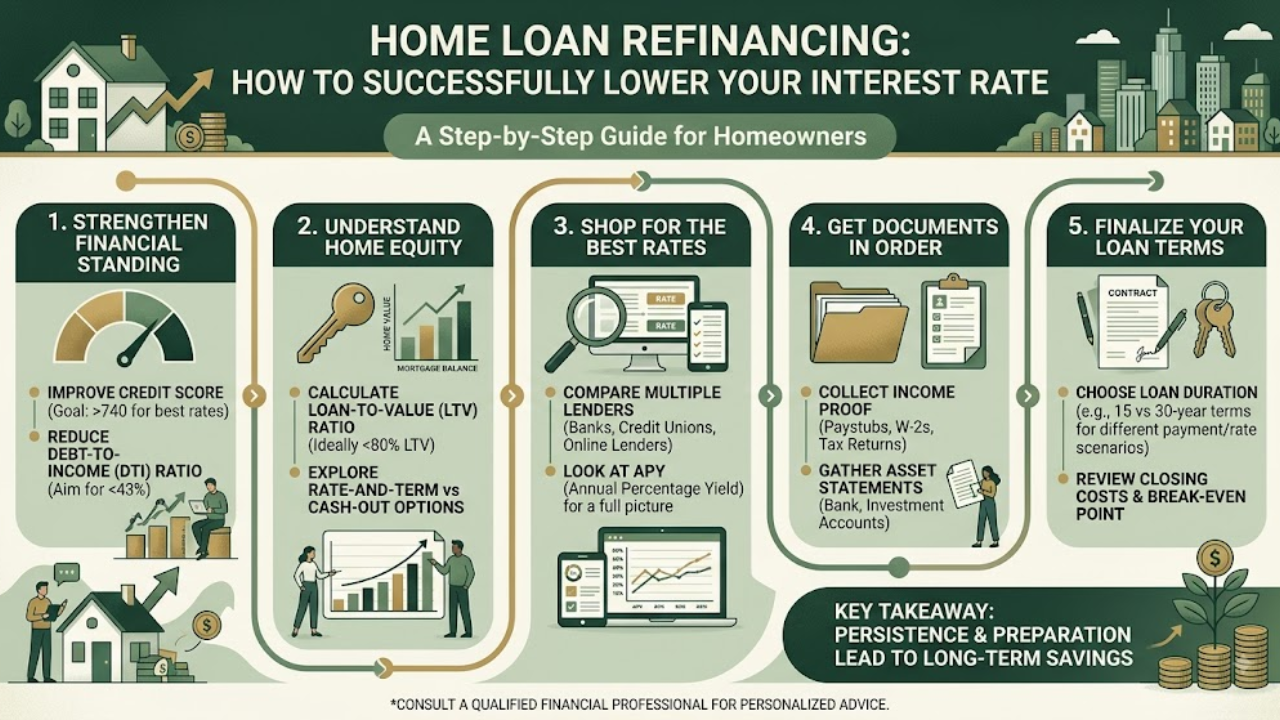
1. Improve Your Credit Score First
Lenders reserve their absolute best interest rates for borrowers with excellent credit. Before you apply for a refinance, check your credit report.
-
Check for Errors: Review your credit report for any inaccuracies that might be dragging your score down and dispute them immediately.
-
Lower Credit Utilization: Pay down existing credit card balances. A credit utilization ratio below 30% significantly boosts your score.
-
Avoid New Debt: Do not apply for auto loans or new credit cards in the months leading up to your refinance application.
2. Calculate Your Home Equity
Your home equity is the difference between your property’s current market value and your outstanding loan balance. Lenders look closely at your Loan-to-Value (LTV) ratio.
-
Target a 20% Equity Cushion: If you have at least 20% equity in your home (an LTV of 80% or less), you will secure much better interest rates and can usually avoid paying Private Mortgage Insurance (PMI).
-
Get a Preliminary Appraisal: Real estate markets fluctuate. Look at recent sales of similar homes in your neighborhood to estimate your current property value.
3. Shop Around and Compare Multiple Lenders
Loyalty doesn’t always pay in the mortgage industry. Your current bank might not offer you the most competitive refinancing rate.
-
Get Multiple Quotes: Request Loan Estimates from at least three different lenders, including traditional banks, credit unions, and online mortgage brokers.
-
Look Beyond the Interest Rate: Pay close attention to the Annual Percentage Rate (APR). The APR includes the interest rate plus broker fees, discount points, and closing costs, giving you the true cost of the loan.
4. Watch Out for Hidden Fees and Closing Costs
Refinancing is not free. Creating a new loan involves administrative, legal, and processing fees. You must calculate the “break-even point” to ensure the refinance is actually profitable.
-
Typical Closing Costs: Expect to pay between 2% to 5% of the total loan amount in closing costs (origination fees, appraisal fees, title search, etc.).
-
Calculate the Break-Even Point: Divide your total closing costs by your monthly savings. (e.g., If closing costs are $3,000 and you save $100 a month, it will take 30 months to break even. If you plan to move before 30 months, refinancing is a bad idea).
-
Check for Prepayment Penalties: Verify if your current lender charges a fee for paying off your original mortgage early.
5. Lock in Your Rate and Finalize the Paperwork
Interest rates change daily based on bond markets and economic data. Once you find a rate that meets your financial goals, act quickly.
-
Request a Rate Lock: Ask your lender for a rate lock (usually valid for 30 to 60 days). This protects you from sudden rate hikes while your application is being processed.
-
Prepare Your Documentation: Gather your recent pay stubs, W-2s, tax returns for the last two years, and bank statements to ensure a smooth underwriting process.
Conclusion
Refinancing your home loan is a powerful way to take control of your personal finances. By improving your credit score, comparing multiple lenders, and carefully calculating the break-even point, you can successfully lower your interest rate and secure your long-term financial health.
Disclaimer: This article is for informational purposes only and does not constitute professional financial advice. Interest rates and loan terms vary by location and individual financial circumstances. Always consult with a certified financial planner or mortgage advisor before making major financial decisions.