
Real estate has long been a cornerstone of wealth creation, offering a proven hedge against inflation and a reliable source of cash flow. However, the way you choose to invest in real estate drastically changes your financial commitments, risk exposure, and daily responsibilities.
Today, investors face a primary crossroads: buying physical properties directly or investing in Real Estate Investment Trusts (REITs). While direct property offers tangible ownership and unique tax advantages, it requires significant capital and hands-on management. Conversely, REITs offer stock-market liquidity and passive income but strip away your control over the underlying assets. Here is a comprehensive breakdown to help you decide which investment vehicle is right for your portfolio.
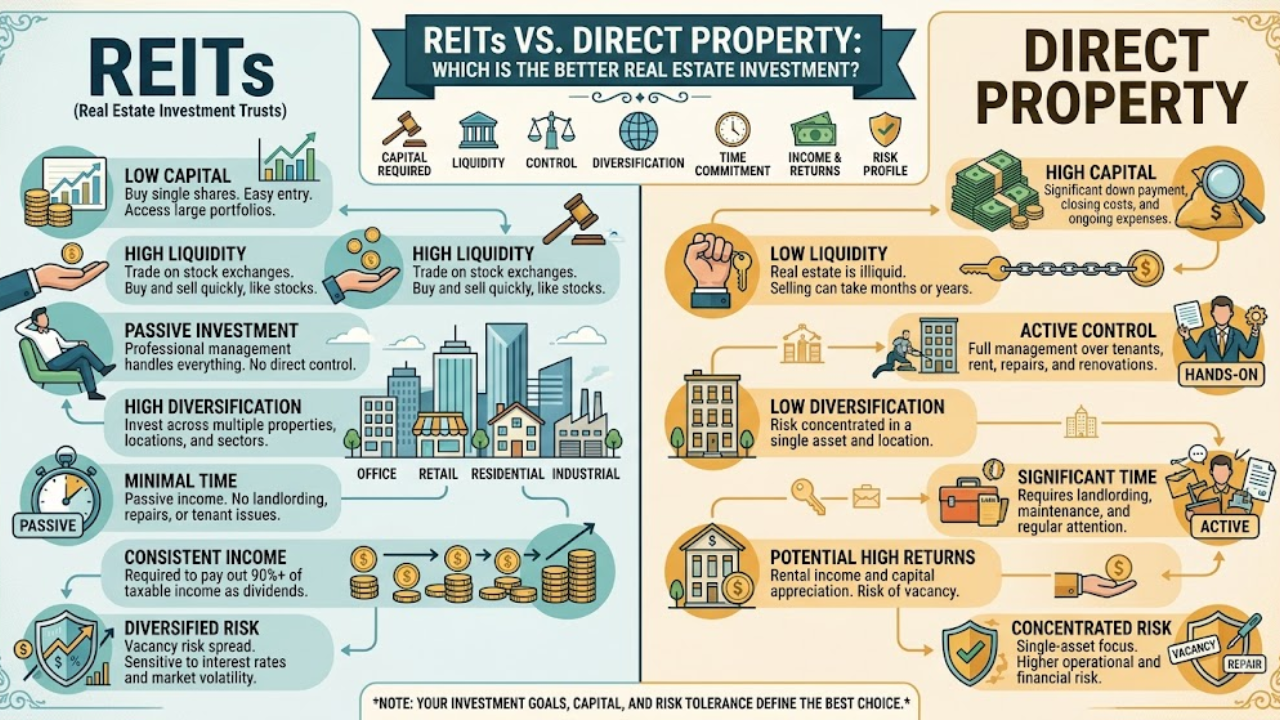
Quick Reference: REITs vs. Direct Property
To determine the best fit for your financial goals, you must evaluate how much time, money, and control you are willing to commit.
| Investment Metric | REITs (Real Estate Investment Trusts) | Direct Property (Physical Real Estate) |
| Capital Required | Low: You can buy single shares for a fraction of the cost of a property. | High: Requires a substantial down payment, closing costs, and a maintenance reserve. |
| Liquidity | High: Traded on public stock exchanges; can be bought or sold instantly. | Low: Highly illiquid; selling a physical property can take months or even years. |
| Time Commitment | Minimal (Passive): Professional management handles all operations and tenant issues. | Significant (Active): Requires hands-on management of tenants, repairs, and maintenance. |
| Diversification | High: A single REIT holds dozens or hundreds of properties across various sectors. | Low: Risk is highly concentrated in a single asset and a specific geographic location. |
| Control | None: You have no say in property management, acquisitions, or sales. | Complete: You have full authority over renovations, tenant selection, and rent pricing. |
1. The Case for REITs (Real Estate Investment Trusts)
A REIT is a company that owns, operates, or finances income-generating real estate. By purchasing shares of a REIT, you pool your money with other investors to earn dividends from real estate investments without having to buy, manage, or finance any properties yourself.
The Advantages of REITs
-
Highly Accessible: You do not need a mortgage or hundreds of thousands of dollars to start. You can invest in a REIT through a standard brokerage account.
-
Consistent Passive Income: By law, REITs are required to distribute the vast majority of their taxable income (typically 90% or more) to shareholders in the form of dividends.
-
Instant Diversification: You can easily invest in specialized sectors that are normally out of reach for individual investors, such as commercial skyscrapers, data centers, or healthcare facilities.
The Drawbacks of REITs
-
Market Volatility: Because public REITs trade on stock exchanges, their share prices are subject to daily market fluctuations and broader economic sentiment, regardless of the underlying property values.
-
Tax Inefficiency: Unlike qualified dividends from standard stocks, REIT dividends are generally taxed as ordinary income, which can trigger a higher tax burden for top earners.
2. The Case for Direct Property Investment
Direct property investing means you are purchasing a physical asset—like a single-family rental, a duplex, or a commercial storefront. You are the landlord, and you are directly responsible for the asset’s performance.
The Advantages of Direct Property
-
Powerful Leverage: You can purchase a highly valuable asset using a relatively small amount of your own money (the down payment) while a bank finances the rest. Your returns are based on the total asset value, not just your initial cash investment.
-
Massive Tax Shields: Physical real estate offers unparalleled tax benefits. You can deduct operating expenses, mortgage interest, and utilize depreciation to significantly lower your taxable rental income. You can also use 1031 exchanges to defer capital gains taxes indefinitely.
-
Forced Appreciation: Unlike a REIT, you can actively increase the value of a physical property through strategic renovations, better management, or increasing the rent.
The Drawbacks of Direct Property
-
The “Toilet and Tenant” Factor: Direct real estate is not truly passive. Dealing with late rent payments, plumbing emergencies, and property vacancies requires time, energy, and stress.
-
High Barrier to Entry: Acquiring physical real estate requires excellent credit, a large cash down payment, and a solid financial cushion to handle unexpected repairs.
Conclusion: Which Should You Choose?
There is no universally “better” option—only the option that best fits your current financial reality.
If you want truly passive income, have limited starting capital, and prioritize liquidity, REITs are the clear winner. However, if you have substantial capital to deploy, want to maximize tax advantages, and are willing to take on the active responsibilities of a landlord to build generational wealth, Direct Property is the superior vehicle. Many well-diversified investors ultimately choose to hold a combination of both.
Disclaimer: This article is for informational purposes only and does not constitute professional financial or investment advice. Real estate markets carry inherent risks. Always consult with a certified financial planner or real estate professional before making major investment decisions.