
As your income grows, your tax liability increases significantly. For high earners, taxes often represent the single largest annual expense, with top federal, state, and local rates consuming over 40% of total revenue.
However, earning a high income does not mean you have to hand over a massive chunk of your hard-earned wealth. The tax code contains built-in incentives designed to reward specific behaviors, such as investing in capital assets, providing retirement security, and supporting charitable causes. By utilizing proactive, legal tax mitigation strategies, high-income individuals can legally protect their assets, maximize capital growth, and keep more money in their portfolios.
Quick Reference: Top Tax Reduction Strategies
| Strategy | Primary Benefit | Best Suited For | High CPC Target Keywords |
| Maxing Tax-Advantaged Accounts | Pre-tax deductions and tax-free growth | High W-2 Earners & Executives | 401k max contribution, Mega Backdoor Roth |
| Real Estate Depreciation & 1031s | Defer capital gains & offset active/passive income | Real Estate Investors & Business Owners | Cost segregation study, 1031 exchange rules |
| Municipal Bond Portfolios | Federal (and often state) tax-free interest income | High Net Worth Investors | Tax-free municipal bonds, Wealth management |
| Donor-Advised Funds (DAFs) | Upfront tax deductions for charitable giving | High Earners with Peak Income Years | Donor advised fund tax benefits, Tax attorney |
| Tax-Loss Harvesting | Offsets capital gains and up to $3,000 of ordinary income | Active Stock & Crypto Investors | Tax loss harvesting software, Capital gains tax strategy |
1. Maximize Advanced Retirement Accounts (Beyond Standard 401ks)
Standard retirement contributions are a great start, but high earners need to look beyond the basic annual limits to shield larger sums from taxation.
-
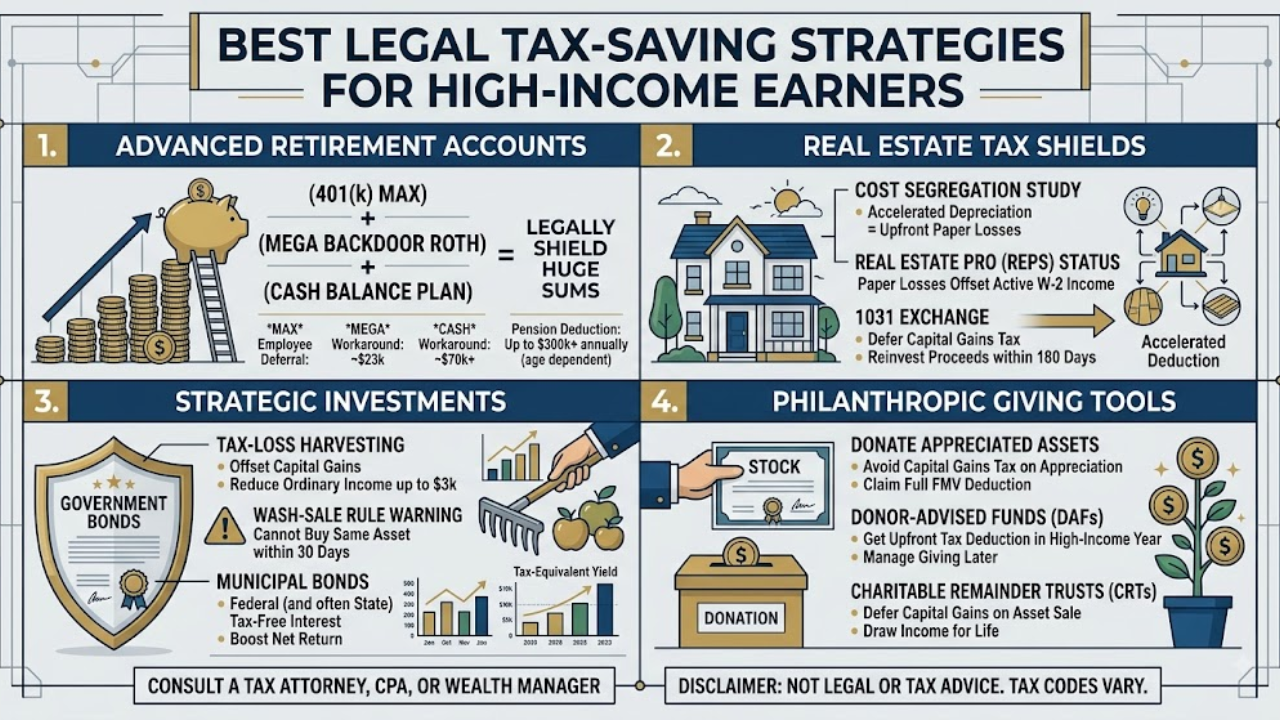
Mega Backdoor Roth IRA: If your employer’s 401(k) plan allows after-tax contributions and in-plan Roth conversions, you can contribute significantly more than the standard 401(k) limit each year into a Roth account, enabling tax-free growth forever.
-
Defined Benefit / Cash Balance Plans: For high-earning business owners and self-employed consultants, setting up a Cash Balance Pension Plan allows you to defer up to several hundred thousand dollars annually in pre-tax income, depending on your age.
-
Health Savings Accounts (HSAs): Often overlooked, an HSA offers a “triple tax advantage”—contributions are tax-deductible, growth is tax-free, and withdrawals for qualified medical expenses are 100% tax-free.
2. Leverage Real Estate Tax Shields and Depreciation
Real estate remains one of the most powerful wealth-building tools due to its unique, highly favorable tax treatments.
-
Cost Segregation Studies: Commercial and residential property owners can use a cost segregation study to accelerate property depreciation. This allows you to write off property components (like lighting, carpeting, and land improvements) over 5 to 15 years instead of 27.5 or 39 years, generating massive upfront paper losses.
-
Real Estate Professional Status (REPS): If you or your spouse qualify as a Real Estate Professional under tax rules, you can use paper losses from real estate depreciation to directly offset ordinary W-2 or business income.
-
1031 Exchanges: When selling real estate, defer paying 100% of capital gains taxes by reinvesting the proceeds into another “like-kind” property.
3. Utilize Tax-Loss Harvesting to Offset Gains
If you hold a taxable investment portfolio, market volatility presents a valuable tax-saving opportunity.
-
Offset Capital Gains: Tax-loss harvesting involves selling underperforming investments at a loss to balance out capital gains realized from profitable assets.
-
Reduce Ordinary Income: If your total losses exceed your total capital gains in a tax year, you can use up to $3,000 of the remaining losses to offset ordinary income, carrying over any remaining losses into future tax years.
-
Mind the Wash-Sale Rule: To preserve the tax deduction, ensure you do not buy the same asset (or a substantially identical one) within 30 days before or after the sale.
4. Invest in Tax-Exempt Municipal Bonds
For investors in the highest tax brackets, income generated from standard savings accounts or corporate bonds can be taxed at steep rates.
-
Federal and State Tax-Free Returns: Interest earned from municipal bonds issued by state and local governments is completely exempt from federal income tax.
-
In-State Exemption: If you buy municipal bonds issued by your home state or local municipality, the interest is usually exempt from state and local income taxes as well.
-
Tax-Equivalent Yield Advantage: Calculate the “tax-equivalent yield” of municipal bonds—often, a lower yield on a tax-free bond delivers a higher net return than a higher yield on a taxable bond for top-tier earners.
5. Implement High-Impact Charitable Giving Tools
If you plan to donate to charity, doing so strategically can significantly lower your taxable income while amplifying your philanthropic impact.
-
Donate Appreciated Assets: Instead of donating cash, donate long-term appreciated stock or real estate directly to charity. You get a tax deduction for the full fair market value and avoid paying capital gains tax on the appreciation.
-
Donor-Advised Funds (DAFs): A DAF lets you make a large, tax-deductible charitable contribution in a high-income year and distribute the funds to charities over several years at your own pace.
-
Charitable Remainder Trusts (CRTs): High earners with highly appreciated assets can place those assets into a CRT, receive an immediate tax deduction, draw income from the trust for life, and leave the remaining balance to charity.
Conclusion
Tax planning is not about evading taxes—it is about structuring your investments and income efficiently within legal guidelines. Because tax laws are intricate and subject to frequent updates, high-income earners should always work with a qualified Tax Attorney, CPA, or Fee-Only Wealth Manager to build a customized, compliant strategy tailored to their financial goals.
Disclaimer: This article is strictly for educational and informational purposes and does not constitute legal, tax, or financial advice. Tax codes vary by jurisdiction and personal circumstances. Always consult with a licensed CPA or tax attorney before executing any complex tax strategy.